KADOE fee requests by car parking management companies in 2024-25.
Research-led public evidence map
Check the charge. Follow the money. Spot the system design.
If you have a ticket, start with deadlines, notice type, and evidence. If you are researching the sector, use the system map to follow DVLA data, appeals, debt, funding, companies, and safeguards.
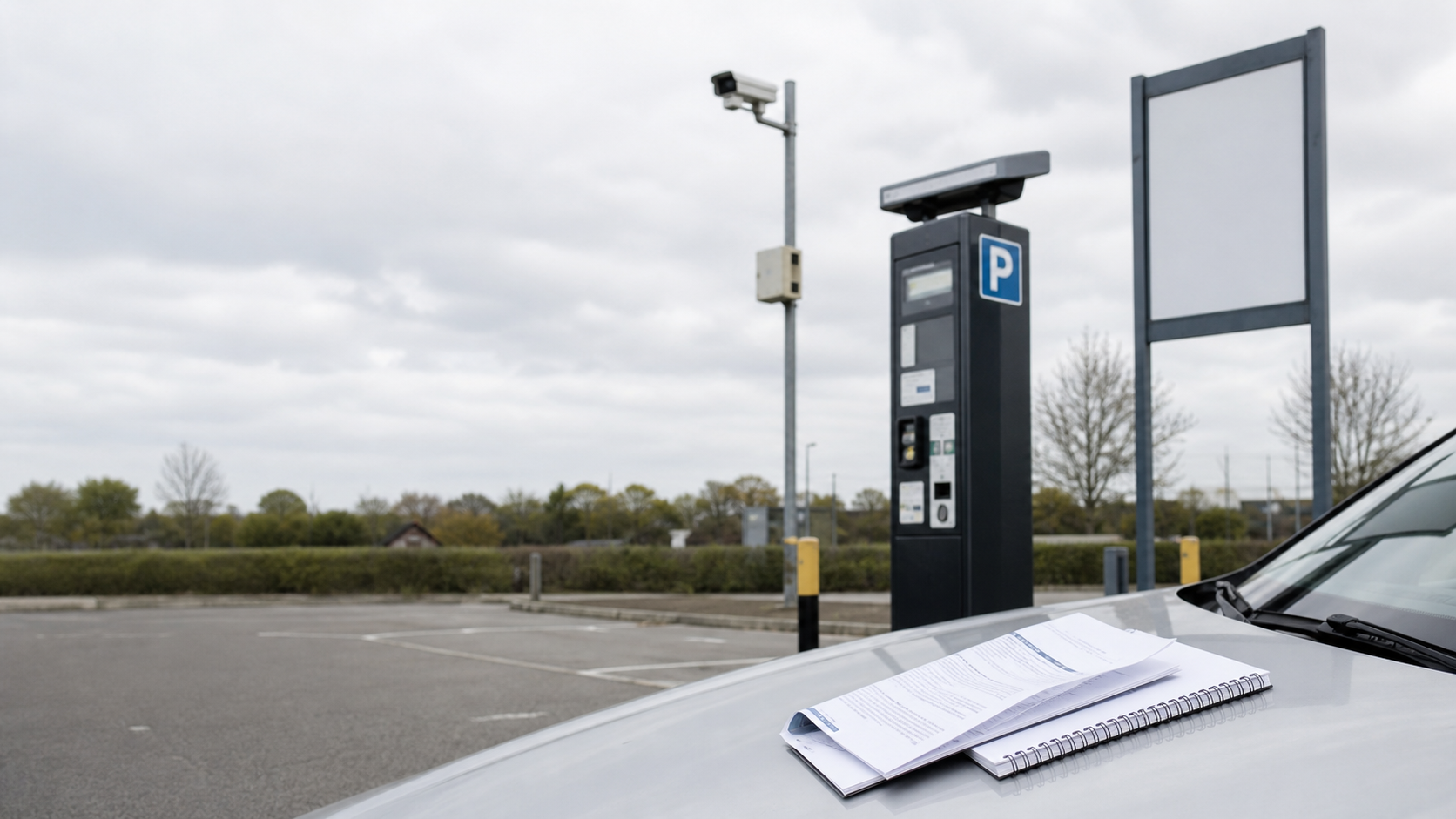
Start here
If you have a notice in your hand, use this five-step route.
- Check the deadline on the notice, appeal letter, Letter Before Claim, or court form before doing anything else.
- Identify the route: private parking charge, council PCN, fixed penalty, toll charge, or something else.
- Keep proof before paying or appealing: signs, payment, app, machine, letters, photos, screenshots, and dates.
- Test the weak points: land authority, signs, timing, payment match, ANPR, DVLA data, accessibility, and human review.
- Use Templates and the Check page for wording, but get case-specific help if court papers or hard deadlines are involved.
Fresh source pass
The first numbers are already big enough to justify scrutiny.
These figures are indicators, not final verdicts on individual companies or cases.
KADOE fee requests already recorded in 2025-26 up to Q3.
estimated UK car parks under private management cited in the 2025 government consultation.
POPLA appeals received between 1 October 2023 and 30 September 2024.
completed POPLA appeals in 2024 where the parking charge was cancelled.
Source dates: DVLA 2024-25 and 2025-26 Q1-Q3 KADOE volumes; GOV.UK private parking code consultation published in 2025; POPLA annual report for 1 October 2023 to 30 September 2024. Sources: GOV.UK DVLA KADOE volumes, 2025 private parking code consultation, and POPLA annual report 2024.
Public route
Start with the notice, then test the system around it.
The public route is simple: identify the type of ticket, keep evidence, check whether the charge was properly created, ask for human review where the system failed, and escalate through the right appeal route.
Check the notice
Work out whether it is a private parking charge, council PCN, fixed penalty, toll charge, or another notice.
Step-by-step checkGather proof
Keep photos, screenshots, receipts, payment records, sign pictures, app logs, disability adjustment requests, and letters.
Evidence listAsk for consideration
Look for clear non-visible disability routes, reasonable adjustments, phone alternatives, and real human review.
AccessibilityFollow the money
Use KADOE volume, appeal outcomes, debt fees, contracts, company accounts, and court behaviour as audit signals.
Money trailFollow the chain from entry to debt
The System page maps what happens from the moment a vehicle enters private land through DVLA data, appeal funding, debt letters, and court paperwork.
Open SystemChallenge the data trail
The DVLA page shows how to complain when keeper data was used for a false charge, and how to ask for correction, restriction, deletion, and recipient notice.
Open DVLAChallenge old records and debt files
The UK GDPR page explains accuracy, retention, deletion, restriction, and whether old databases can be used instead of event-specific DVLA checks.
Open UK GDPRSee who escalates claims
Court Cases separates known sector figures from the missing company-level claim, default judgment, discontinuance, and outcome data.
Open Court CasesSee how the ticket machine grew
Historic keeper request data from 2010/11 onward shows the scale before and after keeper liability, ANPR, apps, and bulk workflows.
Open HistorySee who pays the trust layer
Who Funds Who maps BPA, IPC, POPLA, IAS, Trust Alliance Group, and Flexible Resolution Services without turning funding questions into unsupported accusations.
Open FundingLook at public and staff signals
Review data can show repeated payment, appeal, debt-letter, and workplace-culture themes when it is captured consistently.
Open ReviewsCheck staff culture and churn
Where staff-turnover data is not public, mark it Undisclosed and ask how training, targets, welfare, and quality controls protect motorists.
Open High TurnoverCheck the debt pressure layer
Triangulation compares the collector, review grade, accounts route, conduct rules, and harassment warning signs before debt pressure is trusted.
Open TriangulationCompany profit and CEO pay status
Where a clean public figure is not found, the status should simply read Undisclosed.
Open Company AuditPublic audit tools
The next layer turns concern into structured evidence.
These tools avoid guesswork. They show what is public, what is Undisclosed, what to ask for, and how to protect private evidence.
Methodology
Evidence ladder, Undisclosed rule, source dating, and publication guardrails.
Open MethodTransparency register
What parking operators, debt firms, appeal bodies, and trade bodies should publish on their own websites.
Open TransparencyCompany evidence register
One row per company, with KADOE, accounts, appeals, debt, court, staff, reviews, accessibility, and missing fields.
Open RegisterFOI and SAR templates
Plain wording for operators, DVLA, debt collectors, and ICO complaints when a ticket or data route looks wrong.
Open TemplatesCourt data tracker
Fields for claimant, debt collector, solicitor, amount, default judgment, discontinuance, defended outcome, and data issue.
Open TrackerEvidence backup policy
How to preserve screenshots and source backups without publishing private or sensitive material.
Open PolicyPrivacy & Safety check
ICO, PECR, Ofcom, and Online Safety Act guardrails for keeping this research public while protecting private people.
Open Privacy & SafetyPlain-English glossary
PCN, NTK, KADOE, POPLA, IAS, SAR, CCJ, Letter Before Claim, ANPR, and reasonable adjustment.
Open GlossaryWhat can be said now
The cleanest thesis is system design.
The facts do not support sweeping claims against the whole industry. They do show a system design that may monetise ordinary error, app friction, unclear rules, weak accessibility, and debt escalation unless operators can prove meaningful safeguards.
Data access precedes proof in court
Operators can request keeper data from DVLA where they have reasonable cause and ATA membership. A false positive can therefore still trigger data access and a demand unless later corrected. Source.
Review quality is not transparent enough
The live question is who reviews edge cases, what training they have, how disability is considered, and how often operators cancel before independent adjudication.
Debt letters can distort choices
Escalating sums, legal wording, and credit-file fears can pressure people into paying even where the underlying event deserves human correction.
Use evidence before paying, appealing, or accusing.
This site helps people check the notice type, the evidence, the land, the payment route, the disability and accessibility route, and the escalation path before drawing conclusions. High volume is a reason to ask harder questions, not a verdict by itself.